Reflections From a Depth Psychology Lens
This article is part of the Things Nobody Says Out Loud series—reflections on dreams, grief, art, symbolism, ritual, and healing through a depth psychology lens.
Things nobody says out loud:
The image understands you before you understand yourself.
As both an artist and Jungian art therapist, I have witnessed this truth throughout my life.
Again and again, I have watched an image reveal something long before words could explain it.
A painting expresses grief before the painter recognizes the loss.
A symbol appears repeatedly before its meaning becomes conscious.
An image emerges that seems to know something the individual has not yet discovered.
The image arrives first.
Understanding follows.
Things nobody says out loud:
Sometimes the painting is more honest than the person creating it.
Long before I became a therapist, I was an artist.
Art was never simply a hobby.
It was a way of understanding the world.
As a child, I spent hours drawing, painting, imagining, and creating stories.
Art became a place where questions could exist without immediate answers. Images allowed me to explore experiences that words could not fully contain.
Years later, as I studied psychology, I realized that what I had experienced personally was also deeply psychological.
The psyche naturally communicates through image.
This understanding eventually led me toward Jungian art therapy and depth psychology, where I discovered a language capable of describing what I had intuitively known all along.
Things nobody says out loud:
Healing does not always begin with insight.
Sometimes it begins with an image.
Many people assume that healing happens through analysis alone.
We talk.
We reflect.
We gain understanding.
While insight is valuable, some emotional experiences exist beyond ordinary language.
Trauma.
Grief.
Longing.
Fear.
Transformation.
These experiences often emerge symbolically before they become conscious.
This is one reason art therapy can be so powerful.
Art bypasses our usual defenses.
The image often reveals what words are still trying to avoid.
As a Jungian art therapist with more than two decades of clinical experience, I have repeatedly witnessed individuals discover aspects of themselves through image-making that remained inaccessible through conversation alone.
A single drawing reveals grief.
A color carries emotion.
A recurring symbol appears.
A forgotten memory emerges.
The image knows.
Things nobody says out loud:
The unconscious speaks in symbols because some truths cannot be communicated directly.
Carl Jung understood that symbols are far more than decorative images.
A true symbol is alive.
It contains layers of meaning that continue unfolding throughout a lifetime.
This is why certain images fascinate us.
A tree.
A bird.
A river.
A doorway.
A crown.
A snake.
A mountain.
These images appear repeatedly throughout dreams, myths, religions, literature, and artwork because they express universal psychological experiences.
Jung referred to these recurring patterns as archetypes.
The archetypes belong not only to the individual but to the collective human experience.
This is one reason mythology remains psychologically relevant today.
Things nobody says out loud:
The myths that move you are often telling your story.
Throughout my years presenting, teaching, and studying depth psychology, I have become increasingly interested in the relationship between mythology and healing.
Human beings have always created stories about heroes, healers, seekers, wise elders, tricksters, and journeys into darkness.
Why?
Because these stories reflect enduring realities of the psyche.
The wounded healer.
The orphan.
The seeker.
The shadow.
The wise old woman.
The hero’s journey.
We encounter these patterns because we live them.
Myths survive because they continue speaking to psychological truths.
The same can be said about dreams and art.
The psyche repeatedly creates symbolic narratives because symbols help us understand experiences that logic alone cannot explain.
Things nobody says out loud:
The symbols that follow you are asking for your attention.
One of the most influential practices in my own development as both an artist and therapist has been Jung’s concept of active imagination.
Active imagination invites us into conscious relationship with the images emerging from the unconscious.
Rather than dismissing a dream image, we engage it.
Rather than ignoring a symbol, we become curious about it.
Rather than controlling the image, we allow it to unfold.
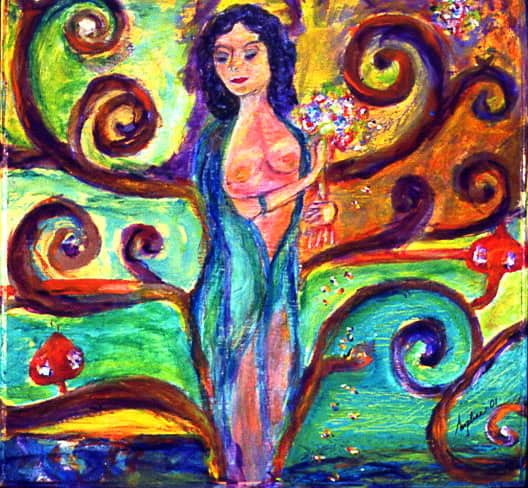
Many of my own paintings emerged through this process.
One image in particular became especially meaningful.
A crowned figure holding a fish in one hand and a tree in the other appeared unexpectedly during the creation of a painting titled Self.
The image arrived before I understood its significance.
Only later did I begin recognizing the symbolic themes emerging through the artwork—growth, transformation, wisdom, nourishment, intuition, and psychological development.
The image understood something before I did.
Things nobody says out loud:
The image often knows where healing is needed before we do.
This observation has shaped both my art and my clinical work.
Again and again, I have watched the psyche reveal itself through image.
Not because people are trying to create profound artwork.
But because the unconscious naturally seeks expression.
The image becomes a bridge.
A bridge between conscious and unconscious.
Between intellect and emotion.
Between what is known and what is waiting to be discovered.
Things nobody says out loud:
The goal of art therapy is not artistic perfection.
The goal is relationship.
Relationship with imagination.
Relationship with emotion.
Relationship with creativity.
Relationship with the unconscious.
Relationship with the self.
When people tell me they are not artistic, I often smile.
Art therapy is not about talent.
It is about attention.
It is about listening.
It is about allowing images to reveal what words cannot.
This is why art continues to matter.
This is why symbols continue to matter.
This is why myths continue to matter.
The psyche is continually attempting communication.
Things nobody says out loud:
The image you have been searching for may already be searching for you.
This is what continues to inspire me after decades as an artist, therapist, presenter, and researcher.
Images are not merely illustrations.
They are invitations.
Invitations to wonder.
Invitations to remember.
Invitations to heal.
Invitations to become.
Because the psyche is always speaking.
And often, it speaks first through an image.
About the Author
Dr. Angelina H. Rodriguez is a Depth Psychologist, Jungian Art Therapist, Dream Therapist, artist, presenter, and researcher with more than 20 years of clinical experience. Her work explores dreams, symbolism, mythology, grief, ritual, creativity, and psychological transformation. She regularly presents on Jungian psychology, art therapy, dream work, symbolic healing, and the relationship between creativity and the unconscious.